In this blog I will try to demystify what the term Lane Base means for swimmers, and touch on subjects like swimming with a Masters swim group, using a swim pace clock, and a few thoughts on lane etiquette.
What is a Masters swimmer?
Let me start by defining that a “Masters swimmer”, for those that don’t know, is simply an adult swimmer, 18 years of age or older, who participates in organized swimming programs, clubs, or competitions. I.e., adults that know how to swim “laps” in a pool with some degree of competency, regardless of speed, and can do them for some extended amount of time.
If you are an adult swimmer and you do not participate with any particular organization, or compete in swimming events, then we “Masters swimmers” generally refer to you as an “open swimmer.” I.e., you swim in a pool during “open lane” times, without a coach on deck and with faster and/or slower swimmers in your lane. Why this matters, and how it relates to what lane base means, will become clearer shortly.
Google result for “masters swimming lane base”
In masters swimming, “lane base” (LB) refers to the time interval used to define the pace of a set of swims for each lane, with swimmers aiming to swim a certain distance (like 100 meters) within that time, and the rest time is based on how much time they finish under the LB.
Here’s a more detailed explanation:
- What it is
- Lane base is a time (e.g., 1:30, 2:00 – m:ss) used to structure a swim workout
- How it works
- Each lane has a designated lane base time. Swimmers in that lane aim to swim a set distance (like 100 meters) within that time
- The faster they swim, the longer the rest before they have to start again
- Example
- If a lane has a 2:00 lane base, and a swimmer swims 100 meters in 1:45, they get 15 seconds of rest before their next swim
- If they swim it in 1:55, they only get 5 seconds of rest
- How to find your lane base
- Ask the coach or experienced swimmers what the lane base is for the 100 free for each lane
- Be honest about whether you can hold that pace in a lane for a set of say five 100’s on the lane base, abbreviated as 5×100 @LB on the workout sheet/whiteboard, before joining it
- Why it’s used
- Lane bases help organize swim workouts and ensure swimmers are swimming at appropriate paces for their skill level
- Moving lanes
- If you find you’re consistently faster or slower than the lane base, you can consider moving to a faster or slower lane
If you get all that, great, but after 30 years of swimming with a Masters club, many people take a long time before they get it, while some maybe just a few swims to figure it out, and how to correctly place themselves in the right lane based on their ability. But then even more importantly, where within the group of swimmers in the lane, where you should swim. This can be a point of contention, so I’ll cover that a bit more later. To be honest, some people never really comprehend the idea, even if they are able to go along with the people in their lane, they just blissfully follow the person in front of them, 10 seconds in arrears.
In a nutshell, joining a Masters swimming group is about swimming with a competitive group of swimmers (those actually competing in Masters swim meets, triathletes, open water swimmers, and people who just swim for fitness), but like, or need, the camaraderie of other swimmers for motivation. The main difference is the presence of a Coach on deck to give them sets to swim, which can make the swimming more fun and challenging, versus just swimming in an open lane and doing your own sets day in and day out. Plus, you won’t have to create the swim sets yourself, or pull them from some place on the internet.
This is why we use lane base to designate the lane in a pool, to ensure that each swimmer is getting the appropriate challenge for the kind of swimmer that they are, as well as being in a pool with other swimmers that are preparing for the multitude of Masters swim meets, open water swims, and triathlons that occur each year. Some pools have very fast swimmers, like Olympic qualifying time swimmers in the fastest lanes (think kids that grew up swimming through high school and college), down to people that take twice as long to swim a given distance, but still like the challenge of pushing themselves.
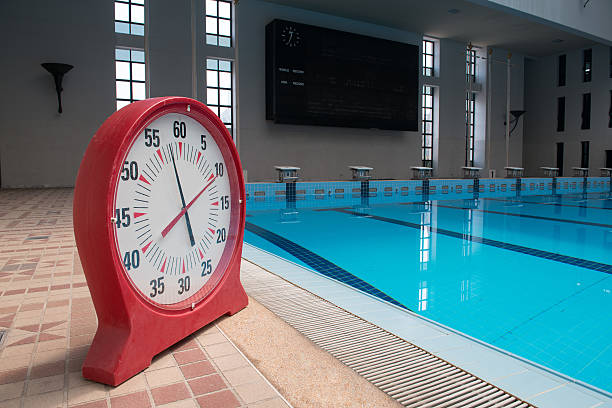
One question you might have right now is how do I time myself while trying to use lane base in the pool? Every pool that I have ever swam in has what we call a pace clock hung up on the wall someplace. In the old days, although they are still available, everyone used a clock like the one in the picture at the start of the blog, while today many of those have been replaced with a simple digital clock showing minutes and seconds (mm:ss).
As a side note, some people use their own watches, stop watches, or heart rate monitors to time themselves. This is fine when you’re swimming by yourself, but if you’re swimming with a Masters group, everyone else is using the pace wall clock which might not synch up with your timing, so please, please, please, use your watch to record your swimming, but do not use it while you’re swimming with others in the lane to time your starts. Triathletes and runners are the worst offenders of this piece of breaking Masters etiquette, so please, when you’re in the Masters pool, you’re a swimmer, act like the rest of the swimmers.
I swim in a seven-lane pool, and traditionally the lane bases were as follows: 1:25, 1:30, 1:35, 1:40, 1:50, 2:00, 2:15+. More recently the lines between the fastest lanes have blurred as lanes were merged, and less and less people are now showing up for the 2:15+ lanes.
Just as a point of reference, to get a sense of how really, really fast swimmers can go, compared us mere “mortals”, here’s the following world records for men and women in the 100m and 100y freestyle:
- 100 meters
- Men – 46.40 seconds
- Women – 51.71
- 100 yards
- Men – 39.90
- Women – 44.83
How do I determine my lane base?
Whether you join a Masters swim program, or just swim by yourself, or with friends during open swim times, if you want to improve your speed and efficiency you should know your lane base before working on doing sets.
Again, simply put, you should be able to do a set of five 100’s on your lane base, 5×100 @ LB. To determine your lane base, I suggest you do a set of five 100’s “strong”, not slow, medium, or fast, but a strong pace that you can maintain over five 100’s, while taking 10 seconds rest between each 100. The idea is to hold about the same pace for all five. When you’re done, take your average finish time for the five 100’s as your lane base starting point.
For example:
- If your average time was 1:52, take a short break, do another set of 5 x 100 @ LB, using 2:00 as your lane base, to see if the 2:00 lane would be appropriate for you
- If you now find that you’re getting less than 5 seconds/100, then you might want to use 2:05 or 2:10 as your LB
- Conversely, if you’re actually getting 15+ seconds/100 rest, then you could try 1:45 or 1:40 as your LB
You’ll find that most pools lane bases are on a ten second interval, so you probably won’t find a Masters program with a 1:55 or 1:45 lane, so you’ll have to decide which lane to swim in. Be forewarned that it’s common in Masters sets to do sets on an interval of LB -5 seconds/100, at which times you may wish to swim in an “easier” lane. E.g. LB-5 in the 1:50 lane means doing 100’s on the 1:45, repeatedly.
One point I want to make clear when you’re swimming in a Masters program, or really even in an open lane time, is the etiquette of sticking to one lane and not moving to an easier lane (i.e., one with a slower LB), depending on how hard you think the set will be, or how tired you might be.
When you’re tired or struggling with a set, simply move back in the lane, maybe all the way to the back, and try to finish the set as best you can in “your lane.” Faster swimmers moving to an “easier” lane when the sets are hard can be disruptive on that lane’s chemistry, the order in which people swim, as you would likely be expected to lead the lane, where you’ll probably drop the people behind you while getting much more rest than them.
More about joining and swimming with a Masters group in Part II, so for now if you’ve never swam sets on a lane base, I hope this primer gives you the information, and the inspiration, to determine your LB and to begin swimming sets based on that time.
Good luck with your swimming!
 ThePracticalTriathlete